

 Yellowcog is back from the IndyCar series test days at the Barber Motorsports Park in Alabama, USA. We were there working with Rising Star Racing and Sarah Fisher Hartman Racing to fit their car with our Pilot™ physiological monitoring system. SFHR driver, Josef Newgarden, was kitted out with a chest-strap monitor which wirelessly transmitted his heart rate, breathing rate, g-forces, temperature and more, directly into the car's telemetry system so that it can be viewed live at the pit wall and also recorded for later analysis.
 RSR’s mission is to match corporate sponsors with talented young drivers and help them at every stage to achieve their full potential. Rising Star Racing are a great company for us to be working with; their attitude to racing mirrors our attitude to engineering. We all want to see young and old alike learning about, and getting involved with, our industries.
 Sarah Fisher Hartman Racing made us feel very welcome and gave us the time we needed to make sure the Pilot™ technology was 100% ready to go for the days' outings. Fitting is actually very quick but the hectic nature of an event means that a bit more time is needed to make sure everything is perfect. The system is now ready to be used in this year’s Indy 500.
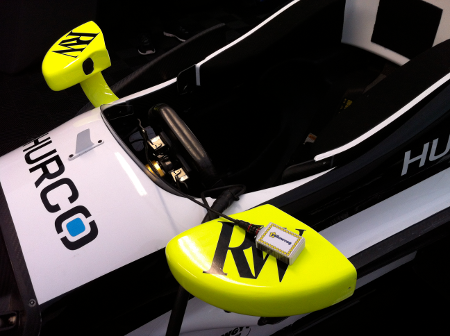
The results from our monitoring were fascinating. We captured a complete set of vital sign data from all of Josef Newgarden’s outings. There were clear changes not only lap by lap but also corner by corner.
Information like this informs training, improves performance and gives a tactical advantage to the team.
Safety is of paramount importance in motorsport, in the now rare event of a serious injury, yellowcog’s system provides medics with immediate access to the driver's vital signs enabling decisions to be made even before reaching the driver.

Yellowcog is now off to the Barber Motorsports Park, Alabama, for the IndyCar testing. Thanks to all those who’ve helped with this project so far. There will be a full report in a few days!

 Rallye-info.com published an article last week (http://www.rallye-info.com/article.asp?stid=11343) about yellowcog’s motorsport driver safety technology, named Pilot™, in the recent rally in Kenya. The article explains how the course medics were able to monitor drivers’ vital signs remotely. The importance of having such physiological information was shown when Geoff Bell and Tim Challen rolled their Datsun 260Z in spectacular fashion!
They both escaped serious injury but the changes in the physiological data in the moments after the accident were dramatic, as can be seen from this Google Earth map. The map shows a combined ‘exertion index’ where the height and colour of the ribbon shows how extreme the vital signs were. This sort of information can be used to tailor the response of the medics, for example by prioritising the person most in need.

 We are proud to announce that yellowcog has been named a Microchip Authorised Design Partner. Yellowcog has decades of experience in designing hardware and software for Microchip devices. Becoming a design partner means that our customers can be sure of our expertise.
We use microchip parts - from voltage regulators to processors - in many of our designs and products. Microchip’s PIC24 and PIC32 range of processors allow us to use the same software libraries across all of our projects. This means in a few clicks we can retarget our software from frugal nanoWatt sensor modules to running power-hungry digital signal processing applications.
Yellowcog specializes in designing with Microchip products. Visit the Microchip Technology web site for more information by clicking here.

The yellowcog logo is now a registered trademark. It's a bold and distinctive logo so we weren't worried that it would be opposed by anyone but it was still exciting to receive an email from the Intellectual Property Office saying that the opposition period had ended and that the mark is now registered (UK00003018234). We haven't decided if or where the little ® is going to go yet (are we the generic-top-right-spot sorts?). The process was all very easy and two things stood out: firstly is that the IPO site is yet another government site (.gov.uk) that works really well (another example would be the HMRC site); second is that by registering a trademark you get a lot of scam "invoices" through the post asking you to pay for further "registration". Amusingly, the IPO themselves were sent a scam invoice by one of these companies when they registered a mark for themselves.